
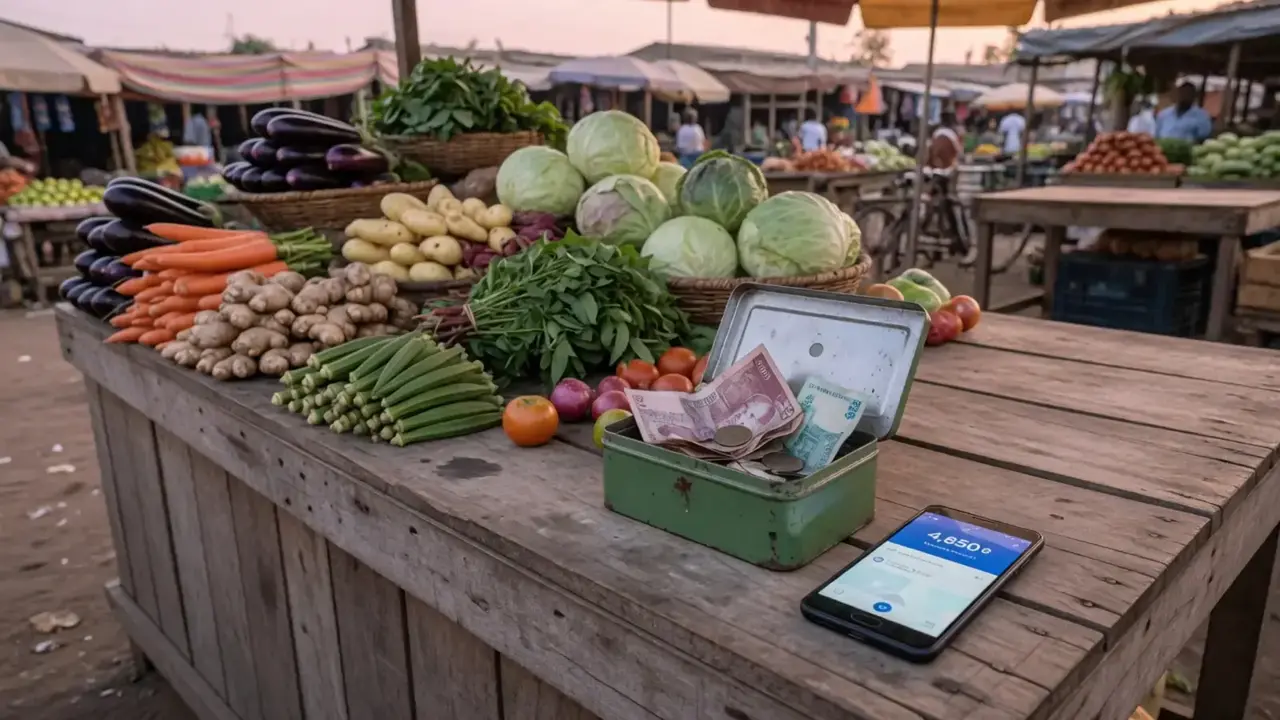
Open a payments conference deck and you will see charts that climb: wallet registrations, QR adoption, card acceptance. Walk a busy trading street at lunchtime and you will also see something those charts rarely weight heavily: people still counting notes, asking for change, and treating a failed cash-out as a full stop on the day.
That is not nostalgia. Cash remains useful because it settles immediately between two people, does not require the counterparty to hold the same app, and works when a phone battery dies. Digital balances are useful because they travel, record, and integrate with licensed mobile-money and bank systems. The friction appears where those two worlds must meet—when someone with a wallet needs notes, or someone with notes needs to pay into a system that only accepts electronic value.
Conversion is the product problem, not “more digital”
Calling a market “cashless” often means merchants prefer digital settlement, not that notes have vanished. Preference still collides with float. A merchant may accept mobile money all morning, then discover they cannot give cash change for a large note. A traveller may hold a bank app balance but need local currency for a taxi that only takes cash. A household may receive a digital transfer and still need physical cash for a market that prices and settles in notes.
In those moments, people improvise: they ask a neighbour, visit a mobile-money agent, queue at an ATM, or cancel the purchase. Each path has costs—time, fees, travel, and uncertainty. Technology platforms that only celebrate the digital leg miss the conversion leg, where trust and liquidity actually get tested.
What licensed rails already do well
Licensed mobile-money providers, banks, and card networks already move value under regulated rules. They hold balances (where applicable under their licences), authenticate customers, and process payments according to their terms. A marketplace that connects people who need cash with people who can provide it does not replace those institutions. It sits beside them: coordination software for discovery and matching, while the payment itself—if any electronic leg is involved—still runs on rails those institutions operate.
That boundary matters. When a platform claims to “solve cash,” readers should ask whether it holds customer funds, guarantees settlement, or simply helps participants find one another. For CaQeh, the operating model is the latter: a technology marketplace for peer-to-peer liquidity matching. Payments occur through existing licensed services such as mobile money, banks, or cards. CaQeh does not take custody of customer funds.
Where cash shortages show up first
Cash shortages are uneven. They concentrate at end of day, around large-denomination notes, after salary dates when everyone wants change, and in places where ATMs run dry or agents hold limited float. Informal markets feel the shortage as stalled trades; formal retailers feel it as longer queues and abandoned baskets. Digital-only narratives treat these as temporary “last mile” issues. Operators treat them as daily operations.
Peer-to-peer liquidity matching does not invent cash. It surfaces who nearby is willing and able to complete a conversion using channels they already trust. The quality of that matching depends on location, timing, payment method preferences, and clear expectations—not on marketing slogans about “financial inclusion” that skip the mechanics.
Practical takeaways
- Treat cash–digital conversion as its own problem, separate from “digitisation rates.”
- Expect licensed institutions to handle settlement; expect marketplaces only to coordinate participants if that is their model.
- Plan for float and change, not only for acceptance logos on a counter.
- When evaluating any platform, ask explicitly whether it holds customer funds—and walk away from vague answers.
Conclusion
Cash still matters because it remains the settlement method many counterparties can complete without shared software. Digital wallets matter because they expand reach and record. The gap between them is liquidity and coordination. If you want tools that help people find nearby liquidity while payments stay on licensed rails, explore how CaQeh approaches participant matching without custody and read the FAQ on platform role and payment rails.